A Career Development Map that shows every consultant what great looks like
To be the very best at what you do, you first need to know what great looks like. This section provides a Career Development Map (typically known as a competency framework) for the nine core areas that make someone a great consultant. It gives your whole team something to grow against: a development plan for every person, and a benchmark for every hire.
The Nine Dimensions™ of the Very Best Consultants
Over two decades we have carried out frontline research, analysis and testing with more than 11,000 consultants, across a wide range of industries and sectors. We wanted to create a Career Development Map that was memorable: everything you need and nothing you don't, when it comes to understanding what growth looks like. Our research continues to evolve, and the map is rigorously tested.
So what does the Career Development Map look like?
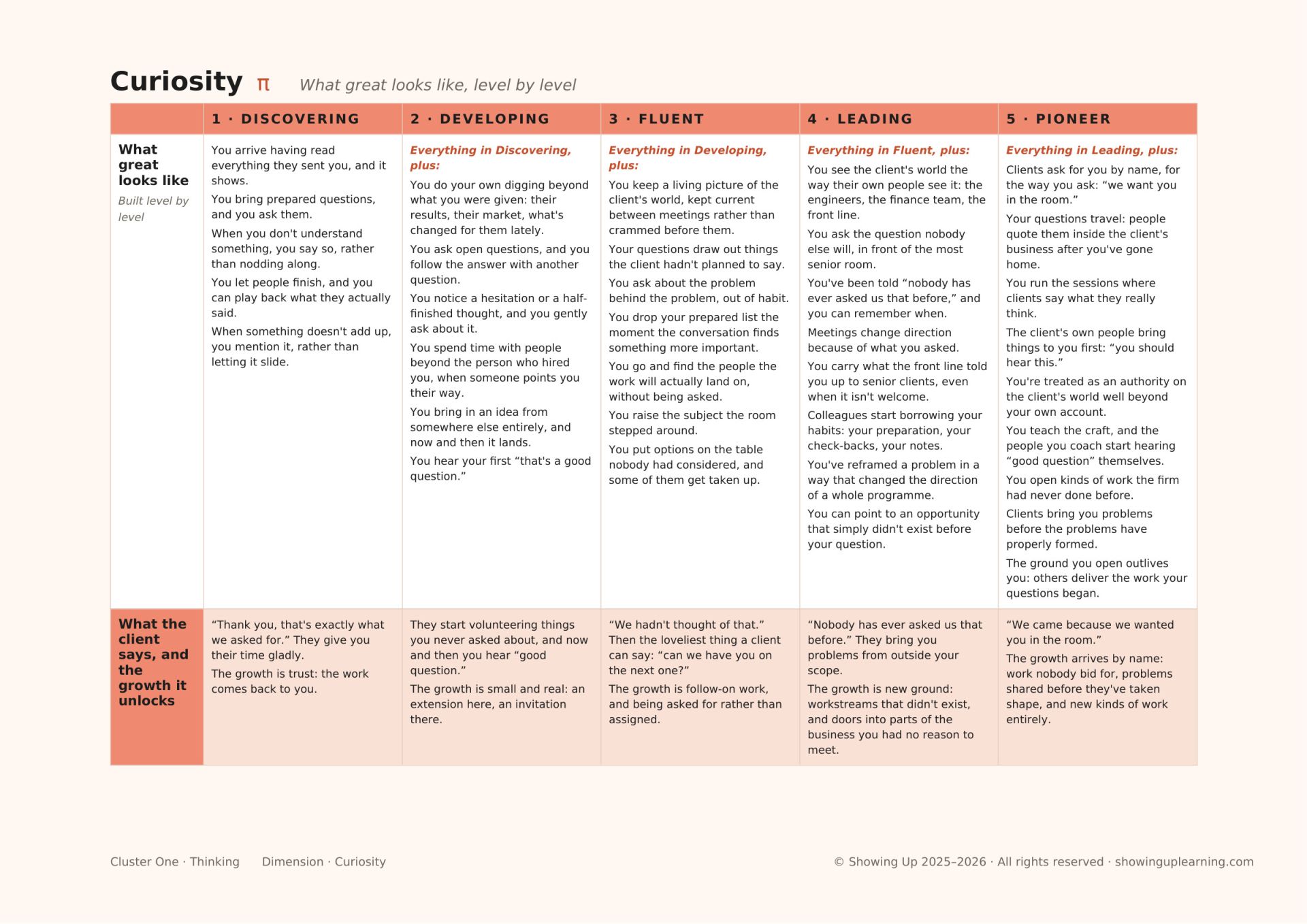
There's a map for every one of the Nine Dimensions™. As an example, here is Curiosity, which you can download and digest. Many of our clients simply take on the base map we've developed as their own, whilst others ask us to tailor it specifically to their organisation. If you'd like to discuss what would work best for you, book a discovery call.
The five levels: from Discovering to Pioneer
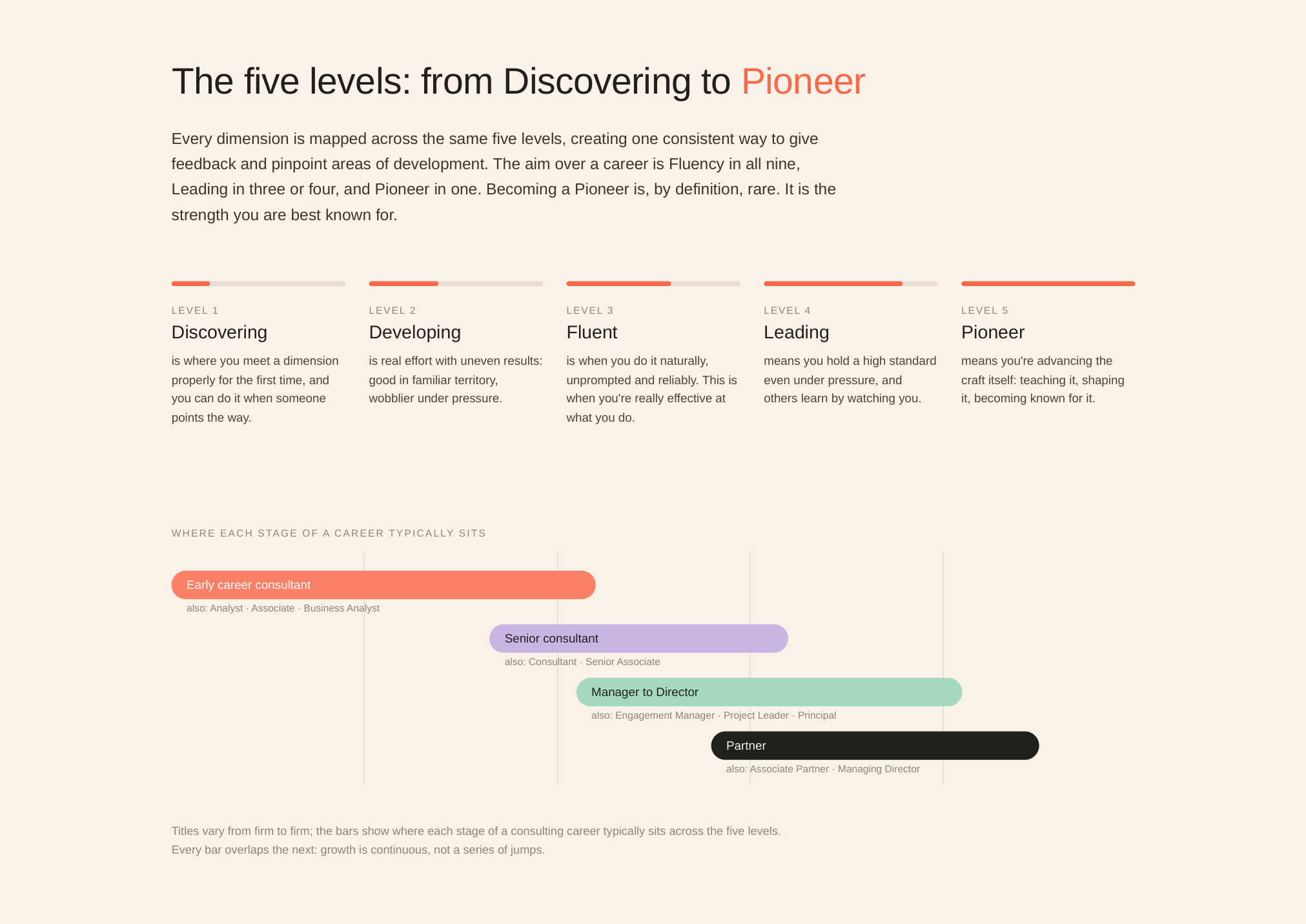
Every dimension is mapped across the same five levels, creating one consistent way to give feedback and pinpoint areas of development. The aim over a career is Fluency in all nine, Leading in three or four, and Pioneer in one. Becoming a Pioneer is, by definition, rare. It is the strength you are best known for.
How the career map enables great development
Many consultants have been told at some point to be more commercial, more strategic, or to show more gravitas: advice that is well-meaning but not always easy to turn into an actionable plan. The Career Development Map makes development practical. Each person can see the exact behaviours of the level they're aiming for, in every dimension, and build a development plan that is truly theirs.
The purpose
The whole purpose of a career map (typically known as a competency framework) is utility. It should make three things clear: where you are, where you are going, and how you will get there. Do that well, and people grow towards their full potential. And when people are growing, you create a culture people love working in, doing the best work of their careers.
Your first week
Imagine this. It is your very first week at the firm, and you are introduced to the Nine Dimensions™ (or any well-crafted career development map). Your line manager and the firm's senior partners all tell you the same thing: when we do these things well, we know we are doing our jobs well. From day one, you know exactly what great looks like here.
Training that links back
Then comes the training. Let's say the focus is Curiosity. Everything in the session links back to the Career Development Map, and through exercises and team games, you see where you did well and where your next growth opportunity lies. Nothing is abstract. It is all connected to one shared definition of great.
Objective and observable
Here is the most important part: the map is objective and observable. It is not opinion, and it is not subjective, as far as that is humanly possible. It is an agreement: these are the things we do to be effective in our roles. That grounding is what lets a career conversation be positive, caring and direct, about exactly where your next leap will come from.
A second language
Over time, something wonderful happens: you stop needing the framework in front of you, because it becomes a second language. We often say to people, "You're aiming for Curiosity three, which means you're fluent." Colleagues walk out of a client meeting saying "that was Curiosity four" or "that was Curiosity two." It becomes a shorthand for what went well and what didn't, and for the constructive conversation that follows.
Learning that finds you
And when someone consistently finds one dimension hard, their learning links directly to it: a one-hour module on nurturing the three forms of curiosity, for example. (This is exactly why we built the Learn element of our platform: on-demand video, ready the moment it is needed.)
Ready before the role
The map also looks forward. Say someone is two years in, and there is a shared belief they will step up to manager in six months. You have already mapped what a great manager looks like, so you can see the gaps, and close them with development, coaching and mentoring before the promotion. They are swimming before they start, ready to hit the ground running.
One map, working everywhere
It quietly improves everything around it, too. End-of-year reviews are grounded in something real. Mentoring pairs pick themselves: partner someone at Critical Thinking four, Leading, with someone at level two, Developing, and both of them grow. One map, doing its job: making it clear where you are, where you are going, and how you will get there.
1 of 8
How the framework supports great hiring
So much of hiring comes down to instinct: impressions formed in the first few minutes of an interview. The Career Development Map changes that, helping hiring managers make hiring engaging, objective and clear. It gives everyone a definition of what great looks like before a single interview begins, so interviews and assessment centres all start from a shared standard.
OUR TEAM, AND WHAT WE PROVIDE
Our behavioural science team, led by Alex Farcas, has built a full ecosystem of tools and support to help our clients hire people who will love their culture and who have the potential to be great in the role. Everything is grounded in the Nine Dimensions™, so what you assess in the interview room is exactly what you'll develop once someone joins. Here's what we provide.
THREE TOOLS, YOUR WAY
We provide three tools for your team. You can use our ready-to-go toolkit, which gives you everything you need straight out of the box, with our team on hand if you need any support. Or we can build something custom for you, shaped around your firm, your roles and your ways of working. Either way, you'll be given three key tools.
TOOL ONE: THE STRUCTURED INTERVIEW
The first tool is how to run structured, competency-based interviews using the Nine Dimensions™. You get the questions to ask for each dimension, guidance on what a great answer actually sounds like, and a simple way to score what you hear. Every interviewer looks for the same things, every candidate gets the same fair chance, and your notes become evidence you can compare, rather than a collection of hunches.
TOOL TWO: INDIVIDUAL TASKS
The second is a set of individual assessment centre tasks. We've built three individual tests, and each one tests a different cluster of the framework. Test one covers Thinking: curiosity, critical thinking and creativity. Test two covers Trust: character, communication and collaboration. Test three covers Impact: curation, commercial acumen and coaching. Together they show you how a candidate works when the problem is theirs alone.
TOOL THREE: TEAM TASKS
And the third is the same again for group tasks. Three team-based exercises, one for each cluster, that show you how a candidate works when other people are in the room: how they think together, how they build trust quickly, and the impact they leave on the group. Some things only show up in company, and this is where you see them.
1 of 5
Looking to support your team's growth and development?
Please get in touch with our team for an initial discovery call
Book a discovery call